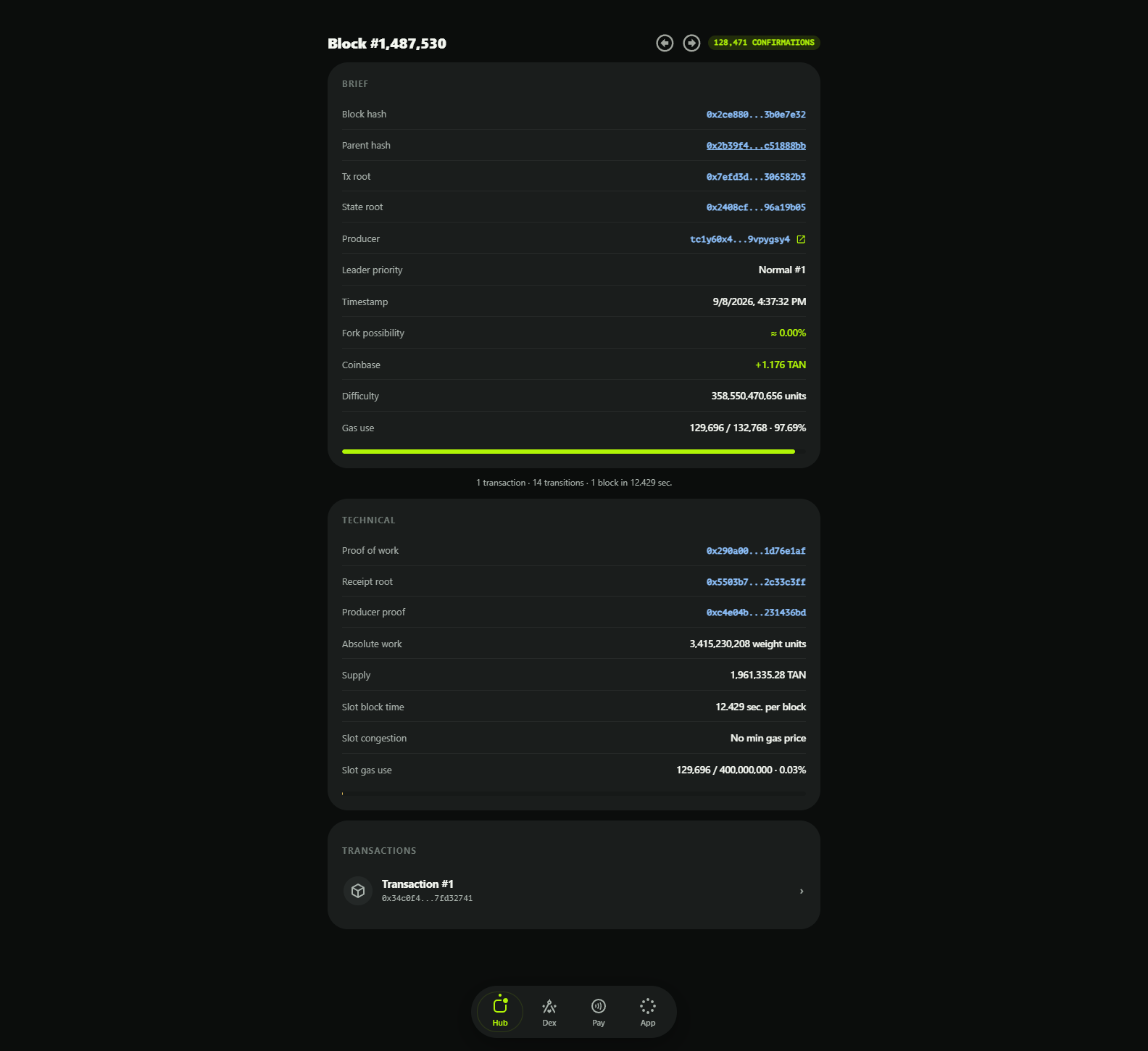
Block Page
The Block page (/block/<number>) shows the full internals of one block: identifiers, proofs, roots and consensus metrics. The header carries the block number, a CONFIRMATIONS badge and arrows to walk to the previous/next block.
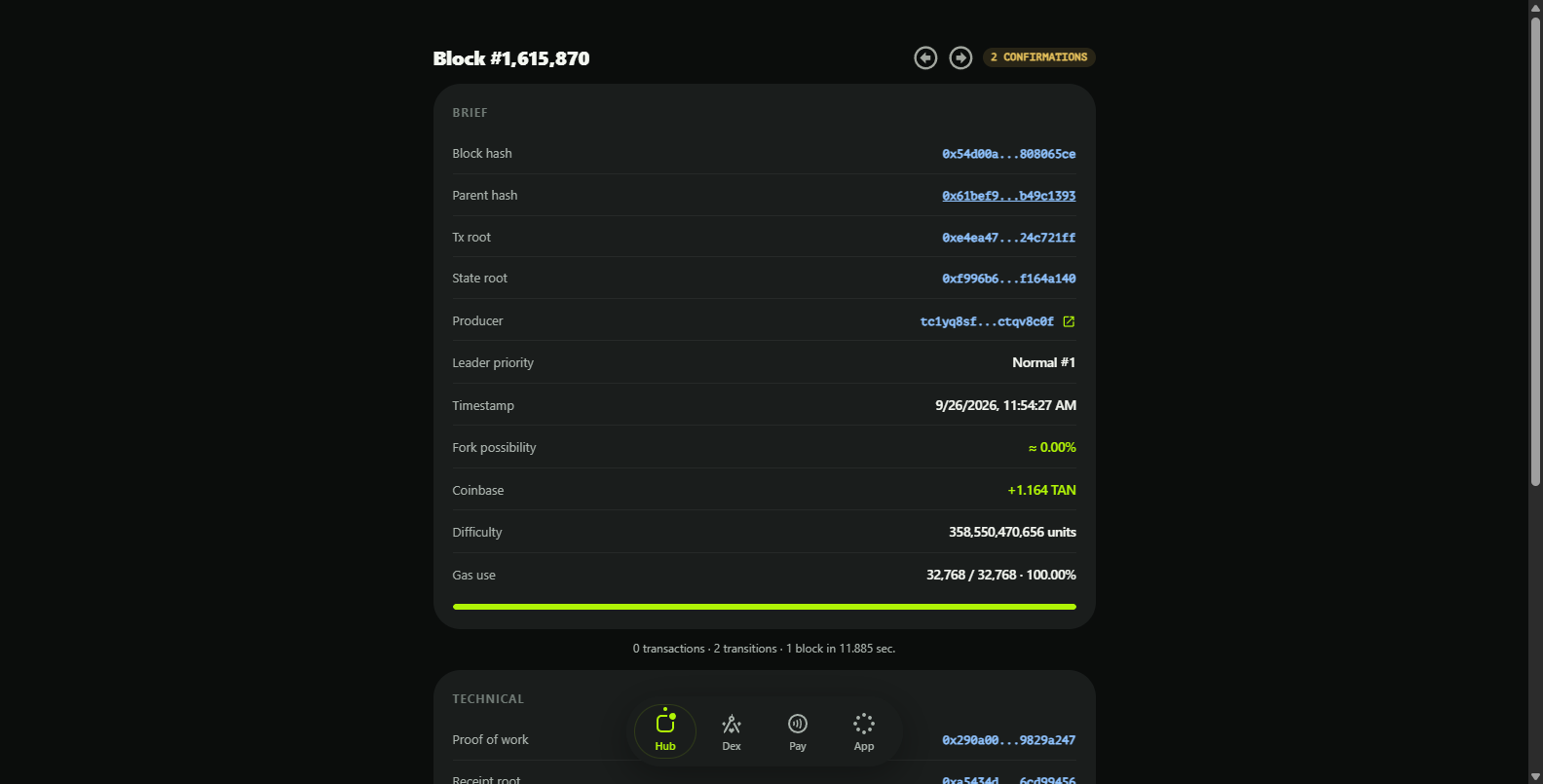
Brief Section
- Block hash — the unique ID identifying this block.
- Parent hash — the ID of the previous block, binding the chain together.
- Tx root — Merkle root of all transaction hashes included up to this block.
- State root — Merkle root of the complete blockchain state after this block.
- Producer — the account that created the block, recovered from the block signature.
- Leader priority — the producer's position in the committee for this slot. A block produced at priority
Unforkable #1has instant finality; anything else is markedNormaland can theoretically be forked. - Timestamp — when the block was evaluated.
- Fork possibility — the estimated chance this block gets orphaned, falling rapidly with each confirmation.
- Coinbase — the TAN minted to the producer as the block reward.
- Difficulty — how hard the block was to produce; blocks not produced by leader #1 carry a difficulty penalty.
- Gas use — gas used by this block versus the block gas limit, with a utilization bar.
The line under the section summarizes throughput: the number of transactions, the number of state transitions and the time it took to extend the chain after the previous block.
Technical Section
- Proof of work — the VDF solution proof demonstrating the work behind the block.
- Receipt root — Merkle root of all transaction receipts, proving execution completed.
- Producer proof — the signature authenticating the block.
- Absolute work — total accumulated work of the chain through this block; the value that decides fork resolution.
- Supply — circulating TAN supply at this block.
- Slot block time — average block time measured across the current slot.
- Slot congestion — the minimum gas price the next block will accept. When the slot gas-use/limit ratio climbs to roughly 25%, the network becomes congested: nodes reject costless transactions and only fee-paying ones are included until utilization drops.
- Slot gas use — total gas used across the slot versus the slot gas limit (max block gas limit × slot length).
Transaction Section
Blocks containing transactions end with a TRANSACTIONS list — every included transaction, indexed within the block and linked to its own page: